
Union Light, Heat and Power in Independence
Kentucky, October 9, 1980
Incident Overview:
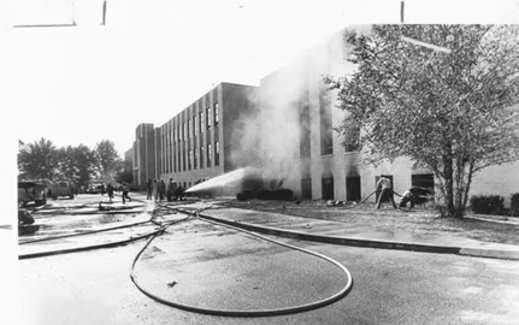
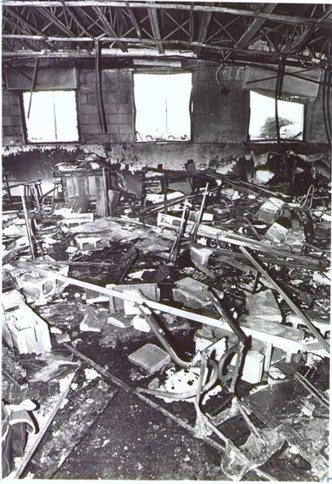
At approximately 11:55 a.m. on October 9, 1980, a 2-inch-diameter compression coupling located on the upstream side of a gas meter set assembly in the boiler room of the Simon Kenton High School in Independence, Kentucky, pulled out of its connection to a 2-inch-diameter gas service line during a scheduled pressure uprating of a 4” steel gas main. Natural gas at 165 psig pressure escaped through the 2-inch-diameter opening and, seconds later, exploded and burned. A basement wall was blown down, an adjacent classroom was damaged, and one student was killed. Approximately 30 minutes later, a second explosion occurred, which injured 37 people and extensively damaged the school. The gas service line was connected to a 4-inch-diameter gas main owned by the Union Light, Heat and Power Company, which was uprating the gas main by controlled pressure increases at the time of the accident.
Contributing to the second explosion was the inability of company personnel to rapidly locate and shut off the service valve for the school service line. The valve could not be located because its valve box lid was not uncovered in the course of the gas company's prior annual inspections.
The National Transportation Safety Board determined that the probable cause of the accident was the over-pressuring and ensuing separation of an unrestrained compression coupling in the school service line inside the school boiler room, which allowed natural gas to escape and ignite. Inaccurate company records failed to show that the school service line was connected to a 4-inch-diameter gas main being uprated to a higher pressure.
Key Findings (Non-Exhaustive) – Refer to Attached NTSB Report for Additional Findings:
Company employees were not aware that the school's service line was connected to the 4-inch-diameter gas main which was being uprated. Incorrect data in the gas company's records led the uprating crew to believe that the school's service line was connected to a 2-inch-diameter gas main instead of the 4-inch-diameter gas main being uprated and therefore was not properly equipped with adequate pressure regulation for the uprating.
The company's employees at the accident site were not aware of and could not quickly determine the location of the street curb shutoff valve, which was unmarked and buried 8 inches below grade. The second explosion could likely have been prevented had company personnel been able to locate and shut off the gas service.
The company did not have a quality control procedure for verifying raw data before it is entered into computerized records systems.
The gas company's inspection program, part of its annual buildings of public assembly leak survey, failed to determine that the curb box was not accessible, and in fact the curb shutoff valve had not been inspected for accessibility for several years, in violation of regulations.
The compression coupling separated from the adjacent piping because the manufacturer's installation recommendations for the use of that type of coupling were not
followed at the time of installation, resulting in excessive gas pressure on the 90° elbow forcing movement of the piping located downstream of the coupling.
No company procedures existed for shutting down the entire system or part of it in an emergency.
Key Lessons Learned (Non-Exhaustive):
Relying solely on records for the planning of work, especially a pressure uprating project, may not address all infrastructure that may be impacted. In areas where there is more than one gas main, a procedure for testing pipelines to validate which pressure gas main the service is attached to may be necessary. Particular attention should be paid to any building of public assembly or other facilities where large groups of people are gathered.
For construction or other types of work where the potential for an AOC may be high, it is important to pre-plan for shutdown in an emergency, and specifically for any uprating project.
The location of high-pressure gas service and meter/regulator assemblies inside of a building is suboptimal, and even more so if located in a confined space or room with ignition sources such as a boiler or other mechanical room.
It is critically important to perform and document findings from all required inspection work and to ensure that any substandard condition is remedied as required by regulation, if not sooner in the case of buildings of public assembly.
The importance of accurate records cannot be overstated. The capturing and verifying of accurate information during installation, replacement, inspections, mark outs of facilities, or at any time facility data can be captured and updated, is critical to pipeline safety.
Key Considerations (Non-Exhaustive):
Review your company's approach/procedures for pressure uprating projects to include the lessons learned from this incident, including the handling of dual mains within the scope of work, field verification of records, the relocation of service/meters to the outside as well as the presence of buildings of public assembly or other facilities where large numbers of people live, work, or congregate.
Consider a review of asset data, including meter location, for buildings of public assembly, etc. to determine the level of risk posed by elevated pressure service inside such buildings. Consider relocation of service and meter assemblies to the outside where feasible.
Consider a review of available asset data for the presence of unrestrained compression couplings on gas meter set assemblies for conformance with the manufacturer's installation recommendations and all pertinent regulations. If this asset data is not available, consider adding this data request to inspections or other work types where company employees or contractors can provide this data. (leak surveys, corrosion inspections, etc.)
Consider a review of any pending remediation work for substandard conditions, such as inaccessible service valve boxes, with prioritization on buildings of public assembly, and expedite remediation, as necessary.
Review and consider improvements, including quality controls to ensure the accuracy of company records, including verification of field reports and of written records and maps transferred to computerized/digitized records.
Consider adding these lessons learned to the training for company employees or contractors who either administer or perform public building inspections.
Review NTSB’s Investigation here: https://www.ntsb.gov/investigations/Pages/DCA81AP001.aspx
NGA publishes Industry Remembrance Events in the spirit of continuous improvement. Findings and conclusions are extracted from publicly available reports and may not reflect those of all stakeholders.